
Ad Tech Just Named Its Next Big Category. Here Is What It Actually Takes to Build a UMP.
A Unified Media Platform promises one place to plan and buy media. Delivering on that promise takes more than an agentic interface.
Aperiam just published a piece naming a new category in media buying: the Unified Media Platform, or UMP. Their argument is that these platforms connect directly to the APIs of the major media providers, layer a single interface and an AI decision engine on top, and replace the ritual of logging into each platform separately. You set a campaign up once, push it across platforms, pull the results back into the same place, and let the system analyze performance and inform what comes next.
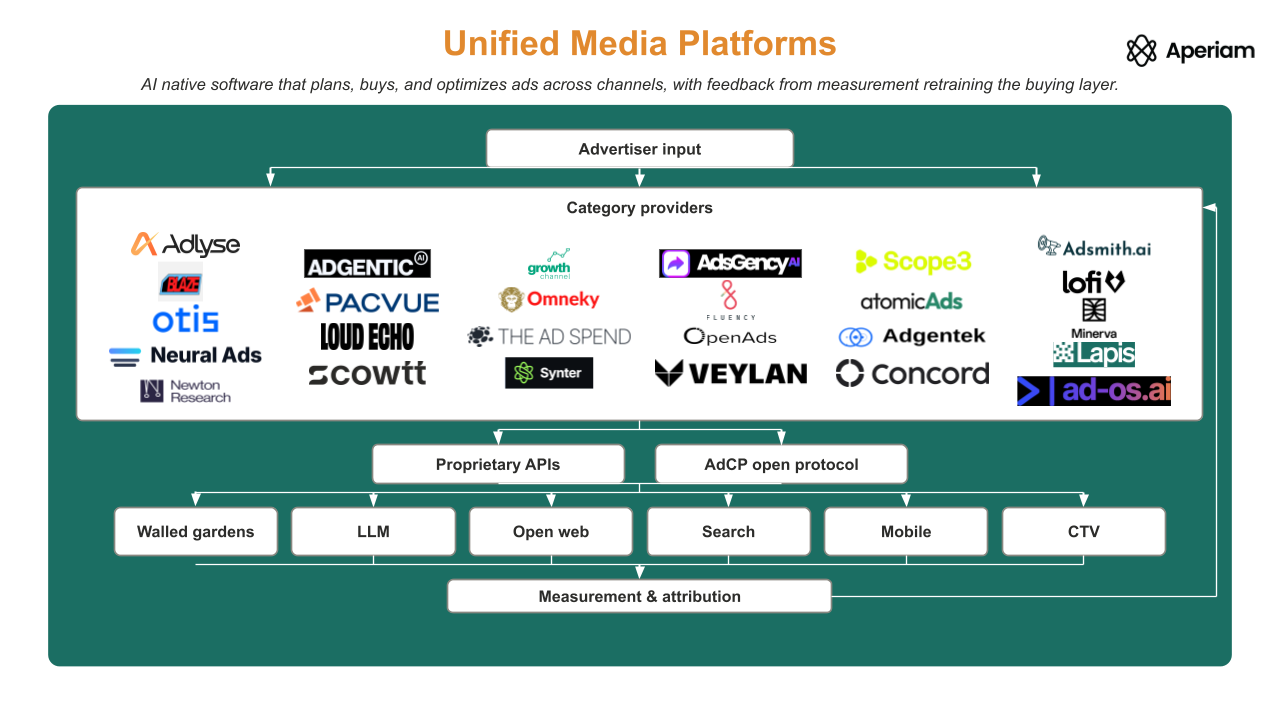
Ad tech does not really believe a category exists until it has three letters. DSP. SSP. CDP. Until then you are explaining yourself in full paragraphs, and full paragraphs do not travel.
So I am glad this one got named, and not for the letters. I am glad because UMP describes exactly what the market has been asking for: a single place to plan and buy media. Set it up once, let it run everywhere, and never log into those platforms again.
We agree on the destination. Where I want to add to the conversation is the part that I think gets underweighted right now, which is what it actually takes to get there.
This is not only an agentic play
Agents are the visible layer. They are also the easiest layer to demo and the easiest layer to copy. If a UMP is just a chat interface bolted onto a set of platform APIs, you have automated the clicking. That is real savings on ad ops overhead, and it is worth having, but it does not change the quality of the decision underneath.
A unifying platform has to do two harder things.
One. Turn bespoke campaign setup into platform native execution.
A media plan is a human artifact. Audience intent, flighting logic, budget rationale, a few constraints that live in someone's head. Every buying platform, meanwhile, has its own object model, its own taxonomy, its own idea of what a line item is and what a segment can be. Getting from the plan to the platform is translation, not transcription.
Do that badly and you get the lowest common denominator campaign, the one shaped by whatever structure every platform happens to share. Do it well and the strategy survives contact with the platform. The same intent expresses itself natively in each environment, taking advantage of what that platform is genuinely good at, rather than flattening everything into a shape that travels easily.
Two. Unify the data so there is one common understanding of the campaign.
This is the part I care most about. A campaign is not three campaigns that happen to share a budget. It is one campaign expressed contextually, expressed against audiences, and expressed natively inside each platform. If those three expressions do not share a common definition, then the data coming back cannot be reconciled, and you are left comparing numbers that only look comparable.
Normalizing that return path into a single measurement layer is what makes the loop worth closing. Without it, cross channel optimization is an assertion, not a capability.
That requires a data and model layer, built for this from the start
You cannot retrofit this. A UMP needs a data and model layer designed from scratch to operate across platforms, and it has to stay flexible enough to pull first party and third party data into the decision itself, not just into the reporting after the fact.
That is the piece that takes years rather than quarters. Identity that resolves across environments. Models that can plan, forecast, allocate, and then explain why. A representation of the campaign that is stable enough for every platform to inherit from and every result to be measured against. Agents sit on top of that and become genuinely useful. Without it, they are a nicer way to do the same fragmented work.
Where we sit
We have been building this since before there was a name for it. The unified data and model layer came first, deliberately, and the agentic execution layer came after, because that is the only order that produces a platform rather than a wrapper.
Seeing the category get named is a real signal. It means the problem is now legible to the market, and that is a good day for everyone building here. But naming a category and building one are different jobs. The companies that matter in this space over the next two years will be the ones who did the unglamorous data work early.
We are glad the industry found the letters. We will keep building the layer underneath them.
Thank you to Joe, Eric and the Aperiam team for the analysis, and for including Neural Ads in it. Work like this is how a category goes from a set of individual bets to something the market can actually evaluate, and we are glad to be counted in it.